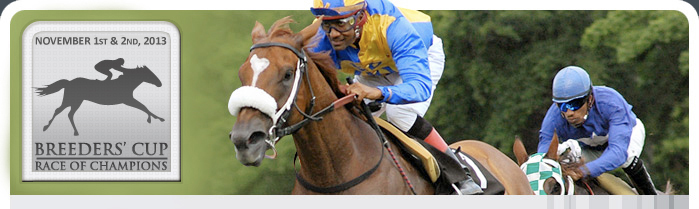
Welcome to Breeders' Cup 2006! Please take a moment to browse our site for the latest in information about this years world
thoroughbred championships at Belmont Park.
The primary goal of Breeders' Cup Limited is to build positive public awareness
of Thoroughbred racing and to expand opportunities for enhancement of the
Thoroughbred industry. These objectives are first accomplished through the
Breeders' Cup Championship, a year-end international showcase of the sport's
greatest stars. Additionally, the Breeders' Cup supports these goals through the
funding of a year-round series of stakes races, consumer marketing programs and
nationally televised races.
It's the All Star Game of Thoroughbred racing - only better. Eight times better.
It's the Breeders' Cup Championship, a multi-million dollar extravaganza that
brings together the world's best horses to compete in eight sensational races.
The Breeders' Cup Championship culminates the racing season and crowns the
fleetest sprinters, the most promising two-year-olds, the best turf horses. The
right to be called the best of the best belongs, many would argue, to the winner
of the day's final and richest race: the $4 million Breeders' Cup Classic.
The Breeders' Cup Championship is non-stop action from the moment the horses
step onto the track for the first race, the Distaff, until the garland is draped
across the shoulders of the Classic winner at dusk. Heart-stopping finishes,
stunning upsets, international glamour, old-fashioned fun - Breeders' Cup
Championship has it all.
Racing's richest event is truly a movable feast. Each fall, a different North
American track plays host to the Breeders' Cup Championship in a unique and
special way. One year finds it at Churchill Downs with its rich trove of
history, another at stately Belmont Park, the next at panoramic Santa Anita in
the foothills of the San Gabriel Mountains. Major tracks compete aggressively
for the right to stage the championship program and each year's selection is
eagerly awaited. At the same time, the revolving nature of the Breeders' Cup
Championship ensures that it belongs to all of racing.
That's just what its founders envisioned when the concept of the Breeders' Cup
took root in 1982. Racing's leaders wanted a vehicle to promote the sport, a
showcase for its finest elements, and a grand finale to the racing season. The
Championship races became the cornerstone of a year-round program which has
allocated more than $380 million to owners and breeders since the inaugural 1984
event. The first Breeders' Cup Championship, at glitzy Hollywood Park, was an
instant hit.
Since then, the Breeders' Cup Championship has redefined the racing calendar -
becoming the season-ending goal for the best horses - and given the sport a
championship event much like the World Series or the Super Bowl. Most divisional
champions crowned since 1984 have participated in a Breeders' Cup race. In
addition to the Classic, the other races are the Juvenile and the Juvenile
Fillies, the Distaff and the Filly & Mare Turf for females ages three and up;
the Sprint, the Mile, and the Turf. The latter three are open to horses of both
sexes, as is the Classic.
The Breeders' Cup Championship has provided racing with some of its finest
moments. Images like these are indelibly etched in its rich chronicles: the
great Cigar ending his perfect 1995 season with a thrilling victory in the
Breeders' Cup Classic; Personal Ensign courageously inching past Kentucky Derby
winner Winning Colors to retire undefeated in 1988; Arazi swooping in from
France and stunning all who saw him in the 1991 Breeders' Cup Juvenile.
"Championship day is unquestionably racing's finest hour," says John R. Gaines,
founding father of the Breeders' Cup and former owner of Gainesway Farm near
Lexington, Kentucky. "It defines our reason for being and elevates the spirit of
an entire industry.
"Each year is special. Each year is better. One of the event's most exciting
elements is the intense rivalry between North American and European contenders.
In almost every race, national pride is on the line. Owners and trainers from
England, Ireland, France, Japan, and Germany now circle the Breeders' Cup
Championship on their calendars and plan their horses' schedules accordingly.
Dozens of European horses board cargo planes each fall and cross the Atlantic in
search of the Breeders' Cup's rich spoils. Their success in many of these races
has ensured that foreign horses keep coming back. Who can forget the gallant
French filly Miesque winning back-to-back editions of the Breeders' Cup Mile? Or
an obscure French-based runner named Arcangues pulling the biggest upset in
Breeders' Cup history, winning the 1993 Classic and paying $269.20 to win?
Horses have journeyed from as far away as Japan to compete in the Breeders' Cup
Championship. It truly has become the foremost international racing event. "The
program was looked at as a revolutionary step when it started, but now it is
considered part of the fabric of American racing," says Breeders' Cup president
D. G. Van Clief, Jr.
The Breeders' Cup Championship continues to grow in popularity because of its
prestige and keen level of competition. Churchill Downs in Louisville, Kentucky,
holds the records for both attendance and total wagering. The renowned
racecourse attracted 80,452 spectators in 1998 and when Breeders' Cup came back
to Louisville in 2000, over $108 million was wagered.
But the Breeders' Cup Championship is known beyond the borders of the particular
host track. NBC has televised the event since its inception, providing a degree
of air time unprecedented in Thoroughbred racing. The network's coverage has won
Eclipse Awards for National Television Achievement and the Outstanding Live
Sports Special of 1992 at the 14th EmmyAwards for Sports annual ceremony.
The buildup to the Breeders' Cup begins well in advance of the Championship day.
NTRA's "Racing to the Breeders' Cup" on ESPN gets the momentum started in early
summer and continues through mid-October. The nationally televised series
consists of dozens of stakes races at major tracks across the country and serves
as racing's version of the playoffs.
In addition to television, simulcasting - the transmission by satellite of
actual races - has helped further the recognition of the Breeders' Cup. At the
same time, the quality of the races on Championship day has made simulcast
outlets eager to carry the program. The number of outlets showing the telecast
is growing by leaps and bounds. In 1984, the seven races were beamed to 19 North
American outlets, where patrons wagered $8 million. Today, over 1000 outlets
handle in excess of $108 million. Expanding its recognition, the actual race
signal is transmitted by satellite to simulcast outlets in over 25 countries,
throughout the Western Hemisphere, Europe and Australia. The continued expansion
of the Breeders' Cup simulcast across the world is a primary goal of the
Breeders' Cup.
Major corporate sponsors also have helped boost recognition of the Breeders' Cup
Championship. Sponsors have included Buick, Alberto-Culver, Budweiser, Delta Air
Lines, Emirates Airline, Mobil, National Car Rental, Visa and Sears.
While sponsors have brought added name recognition to the Breeders' Cup,
Thoroughbred owners and breeders have been its backbone since the beginning.
They not only supply the horses which compete in Breeders' Cup events, they pay
the nominations from which the organization derives its major source of funding.
Stallion owners annually pay a nomination fee that is the equivalent of a
stallion's advertised stud fee, or a minimum of $1,000. Breeders pay a
nomination fee of $500 for each foal. Nominated horses are eligible to compete
for millions in both the National Stakes program and the Breeders' Cup
Championship events.
As an international program, the Breeders' Cup has instituted a nomination
process to breeders around the world. Annual nominations from all over the world
have made the Breeders' Cup a global institution.
In a short time, the Breeders' Cup has been firmly established as Thoroughbred
racing's most prestigious event. Nothing can rival its millions in prize money
or its international cast of talent. No other day of racing can match the
Breeders' Cup Championship for non-stop excitement.
The Breeders' Cup has accomplished what its founders set out to do - and more.
It remains the definitive test of champions and has become racing's most
recognizable and successful showpiece. It only promises to improve in the years
to come. |